

If you got any questions, please do not hesitate to send us a message. We reply within 8 hours !
Don't worry, we hate spam too!



MAKE A BETTER LIFE

Aug 20, 2026
The kitchen is one of the most frequently used areas in any home or commercial environment. From food preparation surfaces and countertops to appliances, sinks, and dining areas, kitchen spaces require regular cleaning to remove grease, food residue, stains, and everyday dirt.
Traditional cleaning methods often require multiple products, sprays, cloths, and water. However, as modern lifestyles become faster and consumers look for more convenient solutions, kitchen cleaning wipes have become an increasingly popular choice for quick and efficient surface maintenance.
Designed for ready-to-use cleaning, kitchen wipes provide a simple way to handle daily messes while reducing preparation time. They are widely used in households, restaurants, hotels, offices, catering facilities, and commercial kitchens.
This guide explores what kitchen cleaning wipes are, their applications, materials, formulation considerations, purchasing factors, and why they have become an important category in the household cleaning market.
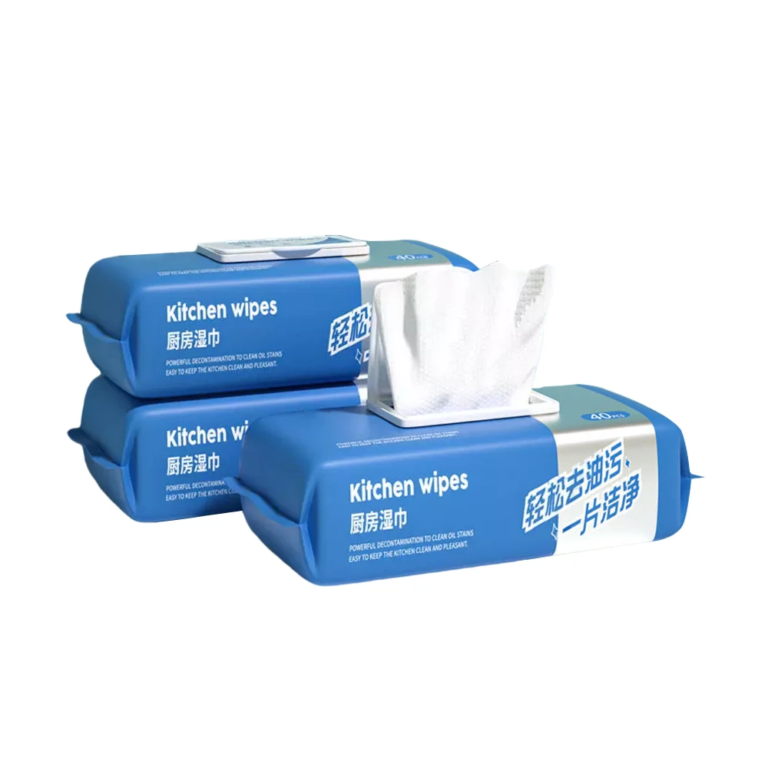
Kitchen cleaning wipes are pre-moistened disposable wipes specifically designed for cleaning kitchen surfaces.
Unlike general-purpose wipes, kitchen cleaning wipes are usually formulated to address common kitchen challenges such as:
Grease buildup
Oil stains
Food residue
Sauce spills
Dust and dirt
Daily surface contamination
Odors caused by food preparation
They typically combine a nonwoven wipe substrate with a cleaning solution that helps loosen and remove dirt from surfaces.
Common application areas include:
Kitchen countertops
Tables
Stovetops
Microwave surfaces
Refrigerator handles
Cabinets
Sinks
Dining areas
Small kitchen appliances
The growth of kitchen cleaning wipes is closely connected with changing consumer habits.
Modern consumers increasingly prefer products that offer:
Convenience
Fast cleaning performance
Easy storage
Reduced preparation steps
Portable packaging
Hygienic single-use solutions
Instead of preparing cleaning solutions and washing reusable cloths repeatedly, users can simply take out a wipe and clean the required area.
Many kitchen cleaning tasks are small but frequent.
Examples include:
Wiping cooking oil after frying
Cleaning food spills after meals
Removing fingerprints from appliances
Refreshing countertops
Cleaning dining tables
Kitchen wipes are especially suitable for these quick cleaning moments.
For families with limited time, kitchen wipes simplify daily maintenance.
They eliminate the need to:
Measure cleaning chemicals
Prepare spray bottles
Find separate towels
Rinse dirty cloths
This convenience makes them attractive for everyday kitchen care.
Kitchen cleaning wipes are not limited to household use.
Commercial users may include:
Restaurants
Cafes
Hotels
Catering companies
Food service businesses
Office kitchens
In these environments, fast cleaning between tasks is important for maintaining a neat workspace.
Kitchen wipes can be developed for different cleaning purposes depending on the target market.
Countertops are among the most frequently cleaned kitchen surfaces.
Countertop cleaning wipes are commonly used for removing:
Food crumbs
Liquid spills
Cooking residue
Dust
Daily stains
Important product characteristics may include:
Good liquid distribution
Effective dirt pickup
Soft surface contact
Adequate wipe size
Grease is one of the most challenging kitchen cleaning problems.
Cooking oils can accumulate on:
Stovetops
Range hoods
Backsplashes
Cabinet surfaces
Appliance exteriors
Grease-focused kitchen wipes are usually developed with cleaning solutions designed to help break down oily residue.
Important considerations include:
Cleaning efficiency
Wipe strength
Formula compatibility
Surface safety
Modern kitchens contain many appliances requiring regular maintenance.
Examples include:
Refrigerators
Microwaves
Coffee machines
Ovens
Dishwashers
Blenders
Appliance cleaning wipes should balance cleaning ability with surface compatibility to avoid unnecessary damage.
Stainless steel surfaces are popular in modern kitchens but often show:
Fingerprints
Water marks
Smudges
Grease residue
Stainless steel kitchen wipes may focus on:
Gentle cleaning
Reduced streaking
Surface appearance improvement
Residue-free wiping
Some kitchen cleaning wipes are positioned for areas that may come into contact with food.
For these products, manufacturers and brands need to carefully consider:
Applicable regulations
Cleaning instructions
Required rinsing procedures
Ingredient suitability
Product claims
Claims related to food-contact use should always be supported by appropriate compliance documentation.
The wipe substrate plays an important role in cleaning performance.
Most kitchen wipes use nonwoven materials because they provide:
Absorbency
Strength
Softness
Liquid retention
Cost efficiency
Common materials include:
Spunlace nonwoven is widely used in wet wipes because it provides a balance of softness and durability.
Advantages may include:
Smooth texture
Good liquid absorption
Strong wet performance
Comfortable hand feel
It is suitable for many household cleaning applications.
Polyester blends can provide:
Higher strength
Better durability
Resistance during tougher cleaning tasks
They may be considered for wipes designed for heavier-duty cleaning.
Some brands focus on sustainability and explore fiber options derived from renewable sources.
Potential benefits include:
Soft texture
Consumer sustainability appeal
Differentiation in retail markets
However, environmental claims should always match actual material properties and certification requirements.
When evaluating kitchen wipes, buyers should consider several technical factors.
A high-quality kitchen wipe should effectively remove:
Oil
Grease
Food particles
Surface stains
Daily dirt
The cleaning formula and wipe structure work together to determine performance.
Kitchen environments often involve liquid spills.
Good absorbency helps the wipe:
Pick up moisture
Capture residue
Reduce repeated wiping
Kitchen cleaning often involves pressure and friction.
A wipe should remain intact during use.
Poor wet strength can result in:
Tearing
Product waste
Poor user experience
Thickness influences:
Cleaning ability
Liquid capacity
Premium feel
Durability
Thicker wipes may be preferred for grease-heavy applications.
Some wipes use textured surfaces to improve dirt removal.
Embossed structures may help:
Increase contact with surfaces
Capture particles
Improve wiping efficiency
However, texture should match the intended surface type.
For retailers, wholesalers, and private-label buyers, selecting the right kitchen wipes requires evaluating multiple factors.
Different markets may require different product positioning.
Examples:
Budget household wipes
Premium kitchen wipes
Heavy-duty grease wipes
Eco-friendly wipes
Commercial cleaning wipes
Wipe dimensions influence user experience.
Small wipes may suit:
Light daily cleaning
Portable packs
Larger wipes may suit:
Kitchen countertops
Commercial kitchens
Heavy cleaning tasks
Important considerations include:
Grease removal ability
Fragrance preference
Surface compatibility
Residue after wiping
Preservation system
The formula should match the intended product claims.
Common packaging formats include:
Soft packs
Flip-top containers
Canisters
Individual sachets
Packaging affects:
Convenience
Shelf life
Transportation
Retail presentation
Kitchen cleaning wipes are a popular category for private-label development.
Brands can customize products according to market positioning.
Possible customization areas include:
Options may include:
Different nonwoven structures
Fiber blends
Thickness levels
Brands may customize:
Fragrance
Cleaning performance
Moisturizing additives
Specialized functions
Customization may include:
Label artwork
Pack size
Wipe count
Packaging format
Brand identity
Private-label kitchen wipes may target:
Household consumers
Retail chains
Online marketplaces
Hospitality customers
Commercial cleaning suppliers
The kitchen wipe market is competitive. Successful products often focus on a clear consumer need.
Potential differentiation strategies include:
Target:
Cooking enthusiasts
Restaurants
Commercial kitchens
Target:
Environmentally conscious consumers
Target:
Sensitive users
Minimalist households
Target:
Consumers seeking higher cleaning performance
Target:
Small households
Outdoor users
Travelers
Kitchen cleaning wipes have become an essential convenience product for modern cleaning routines. Their ready-to-use format, portability, and ability to handle everyday kitchen messes make them popular among households, businesses, and professional users.
For consumers, choosing the right kitchen wipes means considering cleaning performance, material quality, surface compatibility, and convenience.
For brands, wholesalers, and distributors, successful kitchen wipe products depend on more than just manufacturing capacity. Material selection, formulation, packaging, customization options, quality control, and market positioning all influence long-term competitiveness.
As demand for convenient and efficient cleaning solutions continues to grow, kitchen cleaning wipes remain a valuable category for household cleaning brands and private-label product developers.